We all know that traditional 100G optical modules use four 25G optical channels in parallel or wavelength division multiplexing for transmission. Currently, the mainstream optical modules on the market are mainly 100G SR4/CWDM4/PSM4/LR4/ZR4, etc. However, the 100G single-wavelength optical module we are introducing today uses single-wavelength 100G PAM4 modulation technology, which can better reduce production costs and achieve higher transmission efficiency.
I. Comparison between traditional 100G optical modules and 100G single-wavelength optical modules
Traditional 100G optical modules employ 4x25G NRZ technology. Using four independent transmit and receive channels, they can convert four 25Gb/s electrical data signals into four LAN WDM optical signals, which are then multiplexed into a single 100Gb/s optical transmission. At the receiving end, the 100Gb/s optical input is demultiplexed into four LAN WDM optical signals, which are then converted back into four electrical data outputs.
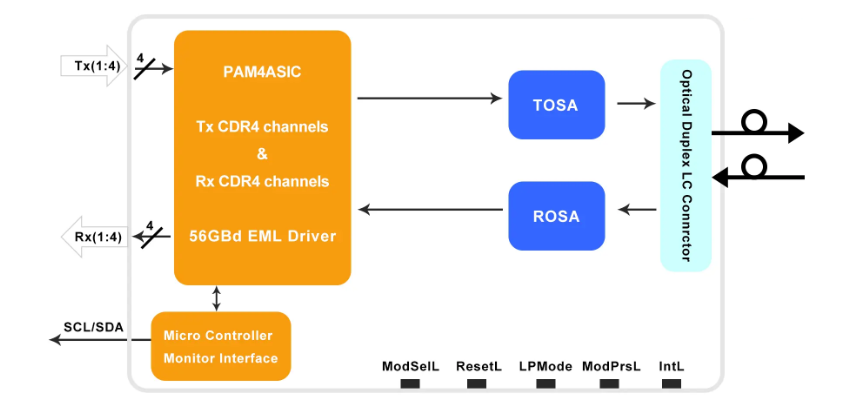
In addition, traditional 100G optical modules require independent transmitter and receiver devices for each channel, which not only increases the power consumption and space occupation of the optical module, but also raises the cost. The 100G single-wavelength optical module, however, drives a cooled electro-absorption modulated DFB laser (EML) to convert four 25Gbps NRZ signals at the circuit end into a single 53Gbps signal through DSP processing of the PAM chip. This technology significantly improves the signal transmission rate and effectively reduces the number of signal channels required compared to traditional NRZ modulation technology.
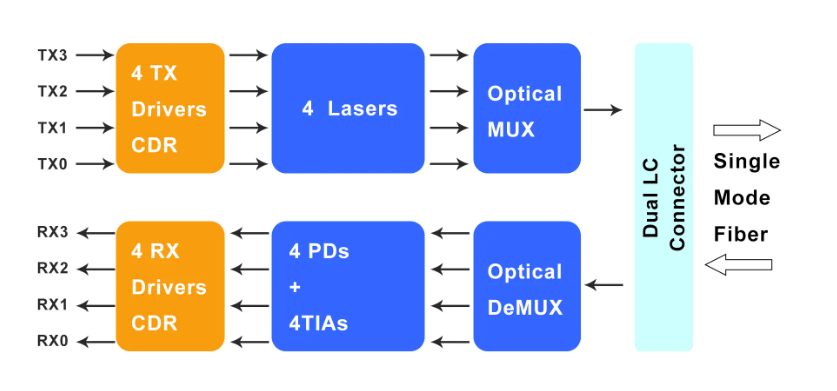
The 100G single-wavelength optical module adopts the more advanced PSM4 parallel transmission technology, reducing the number of optical transmitter and receiver units from four to one, which can reduce costs by more than 40%. Because the 100G single-wavelength technology uses single-channel PAM4 technology, this innovation makes it feasible to upgrade from 100G to 4x100G (400G optical module).
II. Yitian 100G Single Wave Series Products
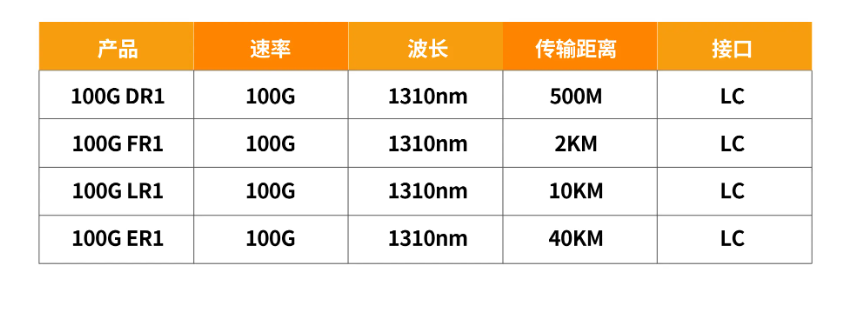
E-Tian currently offers four 100G single-wavelength optical modules: DR1, FR1, LR1, and ER1 (QSFP28). All are suitable for 100Gb/s high-speed data communication using single-mode fiber, operating at a wavelength of 1310nm. The optical signal is multiplexed onto the single-mode fiber using a full-duplex LC connector. This series of products is designed according to the QSFP28 Multi-Source Agreement (MSA) in terms of form factor, optical/electrical connections, and digital diagnostic interfaces. The 100G QSFP28 optical modules can achieve transmission links up to 40 kilometers on single-mode OS2 fiber and are typically used in data center interconnects, 100G Ethernet, and enterprise networks.